





ORGANS OF PARIS © 2026 Vincent Hildebrandt HOME ALL ORGANS


Built between 1854 and 1856, the church is in a
thirteenth‑century style on the outside and neo‑Gothic
on the inside, using metal instead of stone. The vaults
rest on slender colonettes inspired by those in the
refectory of Saint‑Martin‑des‑Champs, but more
elegant thanks to the qualities of cast iron. The walls,
columns and vaults are entirely painted, and the church
is lit by 48 windows filled with stained‑glass windows of
fine craftsmanship. These windows are the work of the
master glassmakers Laurent and Gaspard Gsell for the
large windows, Antoine Lusson for the small apses,
Eugène Oudinot for the low windows under the
galleries, and Pierre Petit‑Gérard from Strasbourg for
the rose window on the façade. Mass is celebrated there
every day in both forms of the Roman rite.

C1
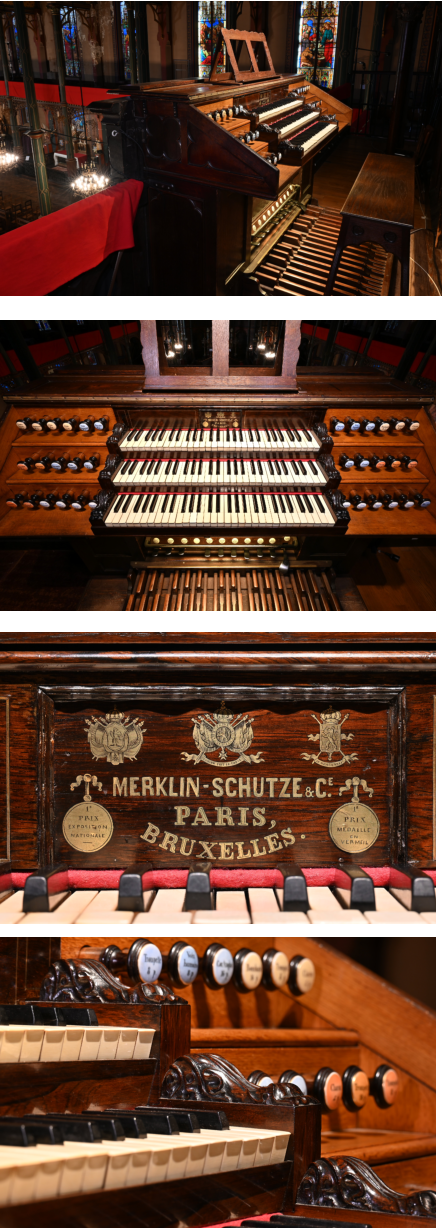
This organ is of the utmost importance: it was the first organ
of Merklin and his voicer Friedrich Schütze in France/Paris,
built in 1854-56. It is almost entirely authentic and a rare
example of a synthesis between French and German-Flemish
organ building traditions at that time.
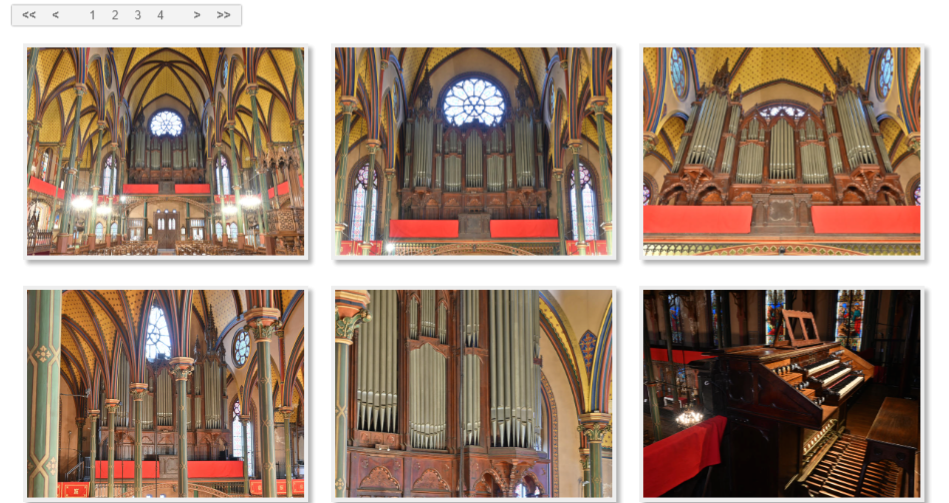
The organ case, in perfect harmony with the surrounding
building, was designed by Louis-Auguste Boileau, the church
architect.
The organ was largely constructed in Bruxelles, just before
Merklin moved to Paris and acquired the Parisian firm of
Ducroquet (former Daublaine-Callinet firm).
The organ was presented at the Paris World Fair in 1855, and
was awarded a First Class Prize. Since Merklin wanted to
present a master piece at the World Fair, he enlarged the
organ (originally designed as a two-manual organ) with a third
keyboard and five additional stops. The enlarged organ was
installed and inaugurated in Saint Eugène in 1856.
There are several distinctive features which make this organ
exceptional and remarkable:
1.
All windchests are cone-valve chests, each pipe having its
own valve. Merklin learned about cone-valve windchests
from Walcker of Ludwigsburg during his appprentice
years.
2.
The Récit is a real third manual (in contrast to the small
‘Echo’ which was common before)
3.
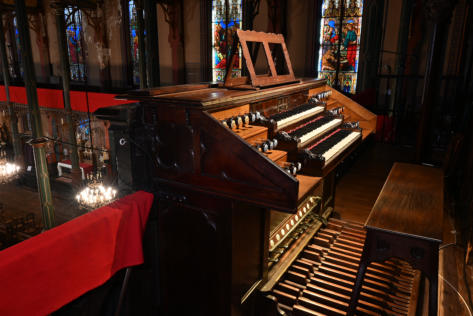
The action of the organ is mechanical with a Barker
machine on the Récit division to which the coupler
machine is linked. The Récit manual (added after the
original conception of the instrument) is thus the
accumulating keyboard. By acquiring the Daublaine-
Callinet firm, Merklin was assured of the expertise of
Barker, who was the leading expert of this former firm.
4.
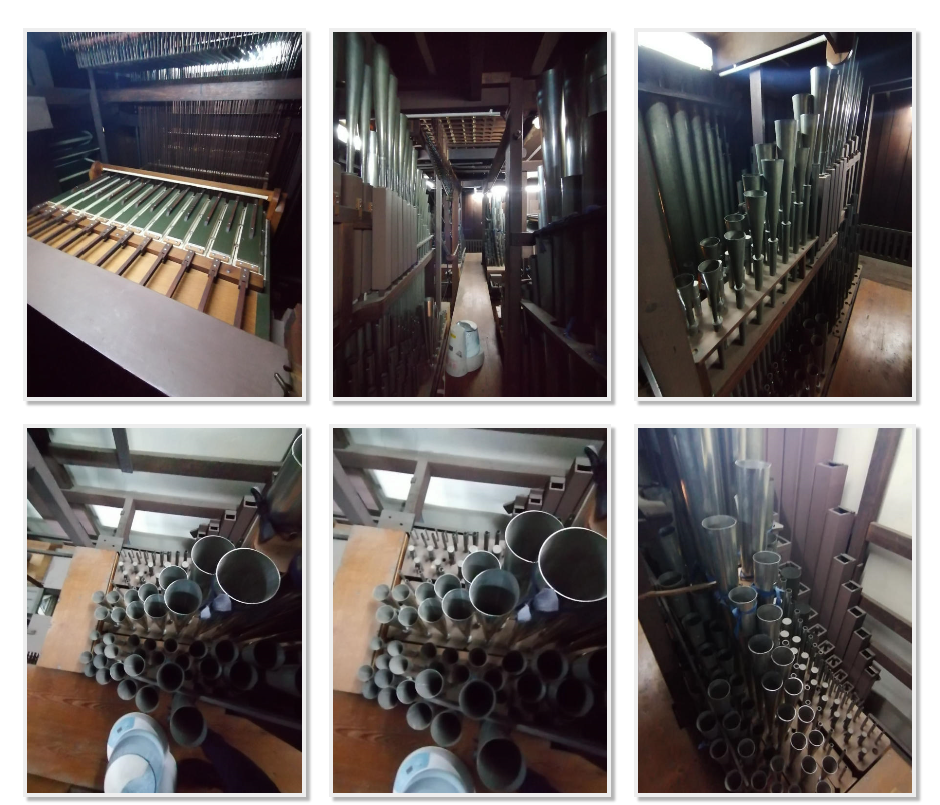
The stops are almost entirely original, with a large variety
(11) of eight foot stops, three flûtes harmoniques (flûte
ouverte GO, flûte octaviante 4 GO and the flûte
harmonique Récit (the flûte harmonique 4 Récit is in fact
not harmonic!) and the use of stops of German origin:
gemshorn (Corne de Chamois), Dolce (very soft flute),
Dolciana. A Voix Céleste is missing. The Clarinette is an
extraordinary stop, having two ranks: a free reed 8
(Clarinette) and a Bourdon 8 starting at c. These two
ranks sound together, but it is possible to open or close
only the reeds in the interior of the organ. This is useful
for the tuning of the bourdon and, by closing the reeds,
one creates one additional foundation stop!
5.
The first use in France of voicing curls (in French:
entailles d‘accord).
The organ was restored with great care and craftsmanship by
Olaf Dalsbaek (Dalsbaek - Merklin company at Miribel ) and
inaugurated in 2005.
2022
Work on the action, carried out by Quentin Blumenroeder.
Source:
Olaf Dalsbaek & Roland Galtier L’orgue Merklin-Schütze de l’église
Saint-Eugène-Saint-Cécile à Paris : une singularité dans la facture
du Second Empire. La Flûte Harmonique Numéro 92, année 2011
- Association Aristide Cavaillé-Coll (in French)


1856 - Merklin-Schütze (1)
2005 - Olaf Dalsbaek (5)
2022 - Blumenroeder (6)
III/32 - mechanical traction
Stoplist
Titular organist
Vincent Rigot
Parish website
Videos
Touve R. Ratovondrahety
Vinccent Rigot
Photos
GO : Jeroen de Haan
Console : Martin Foisset








The organs of Paris


ORGANS OF PARIS © 2026 Vincent Hildebrandt

C1
This organ is of the utmost importance: it was the first organ
of Merklin and his voicer Friedrich Schütze in France/Paris,
built in 1854-56. It is almost entirely authentic and a rare
example of a synthesis between French and German-Flemish
organ building traditions at that time.
The organ case, in perfect harmony with the surrounding
building, was designed by Louis-Auguste Boileau, the church
architect.
The organ was largely constructed in Bruxelles, just before
Merklin moved to Paris and acquired the Parisian firm of
Ducroquet (former Daublaine-Callinet firm).
The organ was presented at the Paris World Fair in 1855, and
was awarded a First Class Prize. Since Merklin wanted to
present a master piece at the World Fair, he enlarged the
organ (originally designed as a two-manual organ) with a third
keyboard and five additional stops. The enlarged organ was
installed and inaugurated in Saint Eugène in 1856.
There are several distinctive features which make this organ
exceptional and remarkable:
1.
All windchests are cone-valve chests, each pipe having its
own valve. Merklin learned about cone-valve windchests
from Walcker of Ludwigsburg during his appprentice
years.
2.
The Récit is a real third manual (in contrast to the small
‘Echo’ which was common before)
3.
The action of the organ is mechanical with a Barker
machine on the Récit division to which the coupler
machine is linked. The Récit manual (added after the
original conception of the instrument) is thus the
accumulating keyboard. By acquiring the Daublaine-
Callinet firm, Merklin was assured of the expertise of
Barker, who was the leading expert of this former firm.
4.
The stops are almost entirely original, with a large variety
(11) of eight foot stops, three flûtes harmoniques (flûte
ouverte GO, flûte octaviante 4 GO and the flûte
harmonique Récit (the flûte harmonique 4 Récit is in fact
not harmonic!) and the use of stops of German origin:
gemshorn (Corne de Chamois), Dolce (very soft flute),
Dolciana. A Voix Céleste is missing. The Clarinette is an
extraordinary stop, having two ranks: a free reed 8
(Clarinette) and a Bourdon 8 starting at c. These two
ranks sound together, but it is possible to open or close
only the reeds in the interior of the organ. This is useful
for the tuning of the bourdon and, by closing the reeds,
one creates one additional foundation stop!
5.
The first use in France of voicing curls (in French: entailles
d‘accord).
The organ was restored with great care and craftsmanship by
Olaf Dalsbaek (Dalsbaek - Merklin company at Miribel ) and
inaugurated in 2005.
2022
Work on the action, carried out by Quentin Blumenroeder.
Source:
Olaf Dalsbaek & Roland Galtier L’orgue Merklin-Schütze de l’église
Saint-Eugène-Saint-Cécile à Paris : une singularité dans la facture
du Second Empire. La Flûte Harmonique Numéro 92, année 2011
- Association Aristide Cavaillé-Coll (in French)
1856 - Merklin-Schütze (1)
2005 - Olaf Dalsbaek (5)
2022 - Blumenroeder (6)
III/32 - mechanical traction
Stoplist
Titular organist
Vincent Rigot
Parish website
Videos
Touve R. Ratovondrahety
Vinccent Rigot
Photos
GO : Jeroen de Haan
Console : Martin Foisset

